Why We Must Build the Ram Temple in South Korea

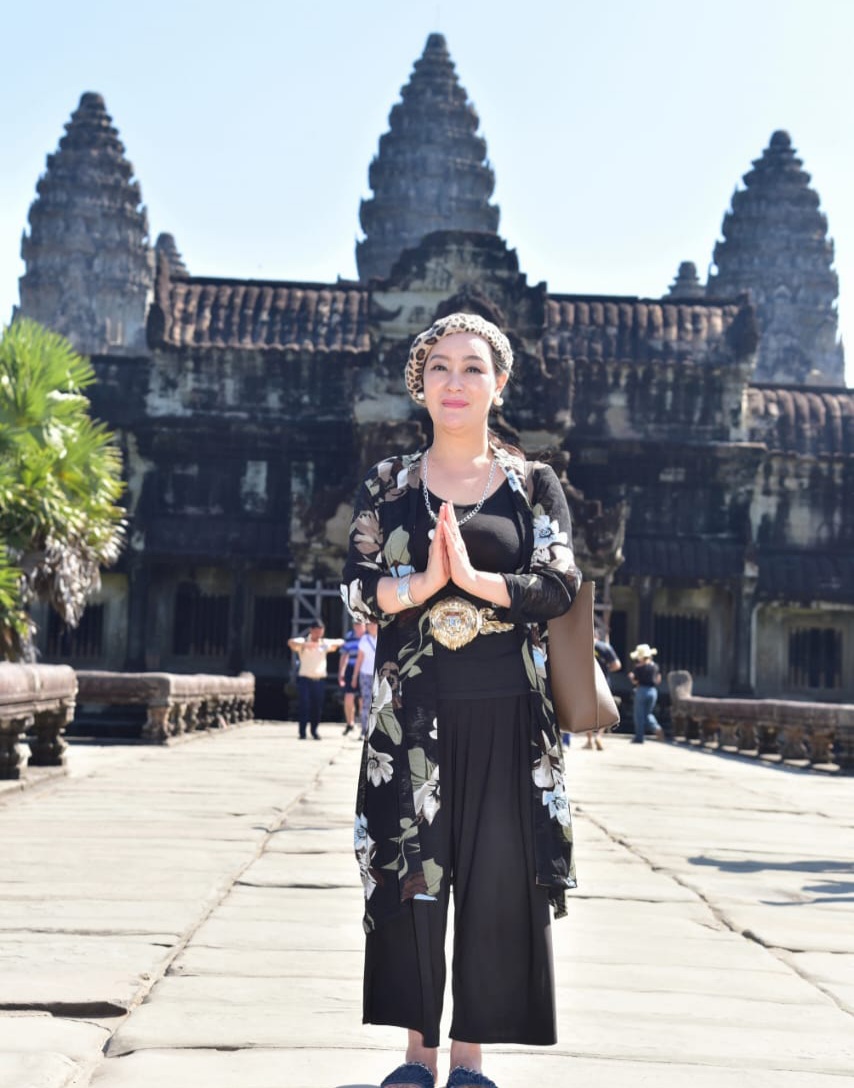
(Dr Zena Chung)
A visit to Angkor Wat is far more than an archaeological excursion. It becomes an intellectual and civilization inquiry—an invitation to reflect on how human civilization was formed, transmitted, and sustained across time. Standing before this monumental stone complex, left behind by the 12th-century Khmer Empire, one is compelled to revisit enduring questions: how have God and humans, and humans among them could coexist within a shared systems of values, order, and meaning?
Located in Siem Reap, Cambodia, Angkor Wat is widely regarded as one of humanity’s greatest civilization achievements, where politics, religion, and cosmological converge are in architectural harmony. Built in the early 12th century by King Suryavarman-II, at the height of the Khmer Empire, the temple complex is not merely a dynastic monument, it is the crystallization of ideas, technologies, and spiritual traditions shaped through continuous interaction between Eastern and Western civilizations. At this place, one realizes here that civilization is never an isolated island, but a vast and flowing continuum connecting regions, generations, and epochs.
Perhaps the most striking testimony to this interconnectedness is found along the first-floor outer galleries of Angkor Wat, where scenes from the Indian epic Ramayana are carved with astonishing precision. The life and philosophy of Lord Ram—the spiritual foundation of Diwali, India’s most significant festival—are preserved not in India alone, but deep within the heart of Southeast Asia. This stands as irrefutable evidence that ancient societies were already bound together through vibrant cultural and spiritual networks.
Even today, local guides passionately narrate the story of Lord Ram to visitors from around the world. The epic is not a relic frozen in time; it remains a living narrative, woven into the cultural consciousness of the region.
This civilization current flowed from India to Sri Lanka, Indonesia, Thailand, Vietnam, Myanmar, and across the Indo-China peninsula—and ultimately reached the Korean Peninsula. The historical account of Queen Heo Hwang-ok, a princess from Ayodhya who married King Kim Suro of Gaya, should therefore not be dismissed as mere legend. Rather, it may be understood as one chapter within a broader story of ancient maritime exchange and civilization movement. History gains depth and clarity when viewed not as isolated events, but as interlinked narratives.
Civilization Is Forged Amid Criticism—and Endures as Legacy
The construction of Angkor Wat itself was not without controversy. Historical accounts suggest that even in its time, criticism arose over the immense financial and human burden imposed on the populace. Similar objections were voiced during the building of the Taj Mahal in India, Eiffel Tower in France or even the Great Wall of China. Yet history is unsentimental. What were once seen as excessive state projects have, over time, become defining symbols of national identity and invaluable cultural and economic assets. Today, Angkor Wat stands as Cambodia’s foremost emblem of world heritage, transforming Siem Reap into an international cultural and tourism hub rivaling the capital, Phnom Penh.
The lesson is unmistakable: national projects of civilization significance must not be judged solely by immediate public opinion or short-term efficiency. They demand a long-term vision—one that considers the inheritance we leave to the future generations.
Re-examining Queen Heo Hwang-ok and the Task of Cultural Diplomacy
From this civilization perspective, the relationship between Korea and India, mediated through Queen Heo Hwang-ok, transcends historical curiosity. She should be re-evaluated not as a mythical foreign bride, but as a historical figure of noble lineage connected to Ayodhya—one of India’s most sacred civilization regions.
That major Korean clans such as the Gimhae Kim, Gimhae Heo, and Incheon Lee trace their origins to this narrative expands the scope of early Korean history and reaffirms the depth of India–Korea civilization exchange.
In this context, discussions surrounding the establishment of a Ram temple in Korea together with Gurudwara under the name of “Global Peace Center for Humanity” should not be viewed as an extension of religious influence. rather, they represent an effort to give spatial and cultural form to ancient civilization ties. At a time when nations actively convert historical narratives into cultural assets and instruments of soft power, such initiatives merit consideration as cultural and diplomatic undertakings beyond the confines of religion.
Ayodhya and the Emergence of a New Pilgrimage Geography
The inauguration of the Ram Temple in Ayodhya on January 22, 2024, and scheduled its full completion for November 25, 2025, symbolizes this renewed civilization momentum. Just as Angkor Wat elevated Siem Reap into a global pilgrimage and tourism centre, Ayodhya now stands poised to emerge as a new civilization gateway for India.
That a non-capital city can connect the world through history, faith, and shared memory, highlights the immense potential of cultural heritage. This development holds important implications for Korea as well. If the 2,000-year-old story of Queen Heo Hwang-ok and King Kim Suro can be reinterpreted and embodied in contemporary cultural spaces, Korea too could emerge as a new global centre of cultural and spiritual tourism.
The Civilization Message: “We Are One”
India’s ancient philosophical principle ‘Vasudhaiva Kutumbakam’—the world is one family—resonates deeply with Korea’s foundational ideal of ‘Hongik Ingan,’ to broadly benefit humanity. In an era marked by geopolitical fragmentation, regional conflicts, and the transition from bipolar to multipolar global orders, these shared civilization values offer more than moral aspiration; they provide a realistic framework for coexistence. At moments such as this, the long-standing philosophies shared by India and Korea can help shape a new international ethic—one that prioritizes peace over war, cooperation over competition, and the well-being of future generations over immediate gain.
Angkor Wat is not merely a monument of stone from the past. It is a question posed to humanity, and a proposal directed at the future. Only when we recover the long rhythm of civilization in our thinking can its meaning be translated into the choices and policies of our present time.
The Prime Minister of India, Mr. Narendra Modi has frequently highlighted on the Somnath Temple’s history of being destroyed and rebuilt multiple times and celebrates 1,000years since the first attack in 1026AD as a testament and a Symbol of Resilience and Pride, an “unbroken courage” and “eternal spirit” of India. His vision includes comprehensive development of the temple complex as a new form of Heritage Preservation and Modern Amenities, which will also include an Exhibition Centre that will generate a Spiritual consciousness and a Pilgrimage Rejuvenation, a new method of Heritage Augmentation Drive.
Now the 21st Century belongs to Asia. The world is noticing the present geopolitical scenario and the power balance have shifted to the Global South. Another important initiative taken by Prime Minister Modi is using Buddhist Philosophy & Buddhism Heritage as the India’s Foreign Policy for Global Peace and Harmony.
His vision for the Nalanda University is to revive its ancient glory as a Premier Global Center of learning and a symbol of India’s commitment to education and world harmony. Nalanda University as a global hub for education, knowledgeand Buddhist heritage. Recently he inaugurated the Light and the Lotus: Relics of the Awakened One. Reclaiming and celebrating India’s Ancient Cultural and Spiritual Heritage. Returning to India, all these gems relics are a symbol of Lord Buddha’s timeless values of peace, compassion and heritage of humanity.
Nalanda University & Buddhism
The key aspects included:
Global Knowledge Hub: The primary objective is to restore India’s past position as a leading center of education and knowledge for the world, attracting students and scholars globally.
Symbol of Shared Heritage: Modi emphasized that Nalanda is not merely an Indian renaissance but a revival of the heritage of many East Asian countries that collaborated in its re-establishment. Ambassadors from 17 countries attended the new campus inauguration, highlighting its international significance.· Modern and Sustainable Campus: The new campus, inaugurated in June 2024, is a state-of-the-art “Net Zero Green Campus” featuring solar plants, water recycling systems, extensive water bodies, academic blocks, a library, and a Yoga Center, blending modern needs with ancient architectural elements.
Promoting Buddhist Ideals: The vision is deeply rooted in Buddhist philosophy, with the campus designed to promote peace, co-existence, and research in Buddhist studies, philosophy, and comparative religions. Modi himself planted a Bodhi tree sapling at the inauguration site, an important symbol in Buddhism.
“Nalanda Way” for the Future: He has urged the youth and scholars to follow the “Nalanda Way” – to be curious, courageous, and kind – and use its knowledge to provide direction to humanity and contribute to the goal of a “Viksit Bharat” (Developed India) by 2047.
The present Spiritual Reawakening should be a joint initiative by the Hon’ble Prime Minister of India with the Indian Diaspora and the Government of the Republic of Korea work together to build a Ram Temple replica, a Gurdwara adjacent to the Buddhist Temple in Seoul, The Republic of Korea which is 2000 years of historical connection under the name of “Global Peace Centre for Humanity.”
The moral values of Lord Ram and also the teachings of Lord Buddha and the teachings from Guru Granth Sahib, is the need of the hour for the whole world. As advocated by the Hon’ble Prime Minister that the world is one family, the teachings from Guru Granth Sahib, the teachings of Lord Ram and the teachings of Lord Buddha are most relevant, in the present world order. There is only ONE GOD but with different names. It is IK ONKAR!
This “Global Peace Centre For Humanity” will promote Cultural Tourism and Spiritual Tourism, which can connect the people from all over the world and South Korea with India could provide a suitable place for the next generation the legacy of Lord Ram and Lord Buddha for a prosperous, happiness to children and a peaceful world, an example to the world to recognize the 2000 years of Indo-Korea historical connections with Queen Heo Hwang-ok, whose life exemplified the true meaning of love, kindness and compassion and the present world to follow India’s philosophical principle as “ Vasudeva Kutumbakam” as ‘One Family.’
Author Dr Zena Chung is Founder and Chairperson of Indo-Korea Business Culture Center (IKBCC)