Bekkersdal Tavern Massacre: A Firearm-Fueled Crisis

Pic Sources: Itumeleng English Independent Newspapers
( Ajit Kumar Singh)
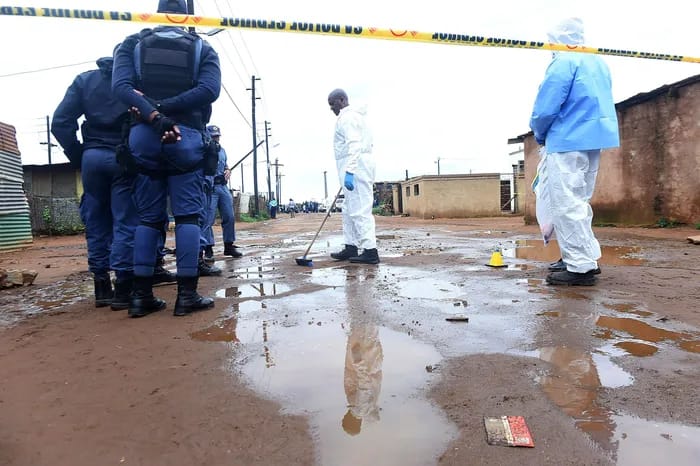
In the early hours of December 21, 2025, the KwaNoxolo tavern in Bekkersdal township, about 40
kilometers southwest of Johannesburg, South Africa, was the scene of a deadly mass shooting that left
nine people dead and at least ten others injured. The attack occurred shortly before 1 am [SST] when
around a dozen armed assailants arrived in a white Toyota Quantum minibus and a silver Toyota Etios.
Armed with at least one AK-47 assault rifle and several 9mm pistols, they opened fire on patrons inside
the licensed tavern and on people gathered outside in nearby streets. After the attack, the assailants
looted mobile phones and other valuables before fleeing, firing sporadic shots as they escaped.


A nationwide manhunt involving the Serious and Violent Crimes Investigation Unit and Crime
Intelligence was launched, but at the time of writing, no arrests had been made. Authorities have not
confirmed a motive, citing possibilities such as gang retaliation, extortion targeting tavern owners, or a
robbery that escalated into mass violence.
The Bekkersdal massacre reflects entrenched patterns of firearm-driven violence in South Africa.
Nationally, an estimated 63 to 70 people are killed each day. The 2024-25 fiscal year recorded 27,494
homicides, a 6.8 percent increase over the previous year. Firearms are implicated in roughly 50 to 60
percent of murders, accounting for an estimated 12,000 to 16,000 gun-related deaths in 2023-24.
Gauteng province remains a major hotspot. It accounts for 36 per cent of armed robberies and 55
percent of carjackings nationwide. Township taverns and shebeens (bars or clubs) are frequent targets,
particularly in communities marked by unemployment levels near 40 per cent, and limited policing
capacity, with police-to-population ratios as low as 1:450. Since the 2022 Soweto tavern massacre that
killed 16 people, shootings in drinking establishments have increased. Gun Free South Africa recorded
80 mass shooting incidents in 2024 – defined as incidents with four or more casualties – declining slightly
to around 70 in 2025 (as of late December).
These “multiple murders” now account for about 15 percent of all killings in the country. Between 2019
and 2024, more than 9,000 people were killed in such incidents, with Gauteng responsible for 28
percent of the total. Illegal firearms are central to this trend. Estimates place the number of illicit
weapons in circulation between 3 million and 3.8 million, weakening the long-term gains of the Firearms
Control Act of 2000, which initially reduced homicides by 17 percent.
The Bekkersdal attack reflects coordinated group violence linked to organized crime. The use of multiple
vehicles, heavy-caliber weapons, and a large group of assailants indicates planning and access to
criminal networks involved in illegal mining, drug trafficking, and extortion. Residents report frequent
gunfire, reinforcing perceptions of impunity and declining trust in state protection. Political responses
have emphasized structural causes, with the South African Communist Party describing the attack as
“barbaric” and rooted in inequality.
The impact extends beyond South Africa. Illicit firearms move across porous borders within the
Southern African Development Community (SADC), often linked to conflict-affected regions such as
Mozambique and Zimbabwe. SADC’s 2024 security assessment reported a 12 per cent rise in regional
homicide rates. Mozambique alone has experienced more than 200 firearm attacks since 2020,
displacing over 1.1 million people. Zimbabwe recorded 142 multiple-murder incidents in 2024, many
tied to cross-border criminal networks.
Globally, Bekkersdal fits a pattern of organized group shootings. Southern Africa and Latin America
account for 35 percent of global mass public shootings despite comprising only 12 percent of the world’s
population. One-third to half of such attacks occur in bars, streets, or entertainment venues, often linked
to arms and narcotics trafficking.
The Bekkersdal massacre underscores the convergence of illegal firearms, organized crime, and
socioeconomic stress. Without sustained intelligence-led policing, effective disarmament, and regional
cooperation to disrupt arms trafficking, similar attacks are likely to continue, reinforcing public fear and
instability
Author Ajit Kumar Singh is Senior Fellow at Institute for Conflict Management.
(The views expressed in the above piece are personal and of the author. They do not necessarily reflect Bharat Fact views.)