China-Russia Joint Bomber Flights Threaten Japan

File pic: Global Times
(Shivangi Sharma)
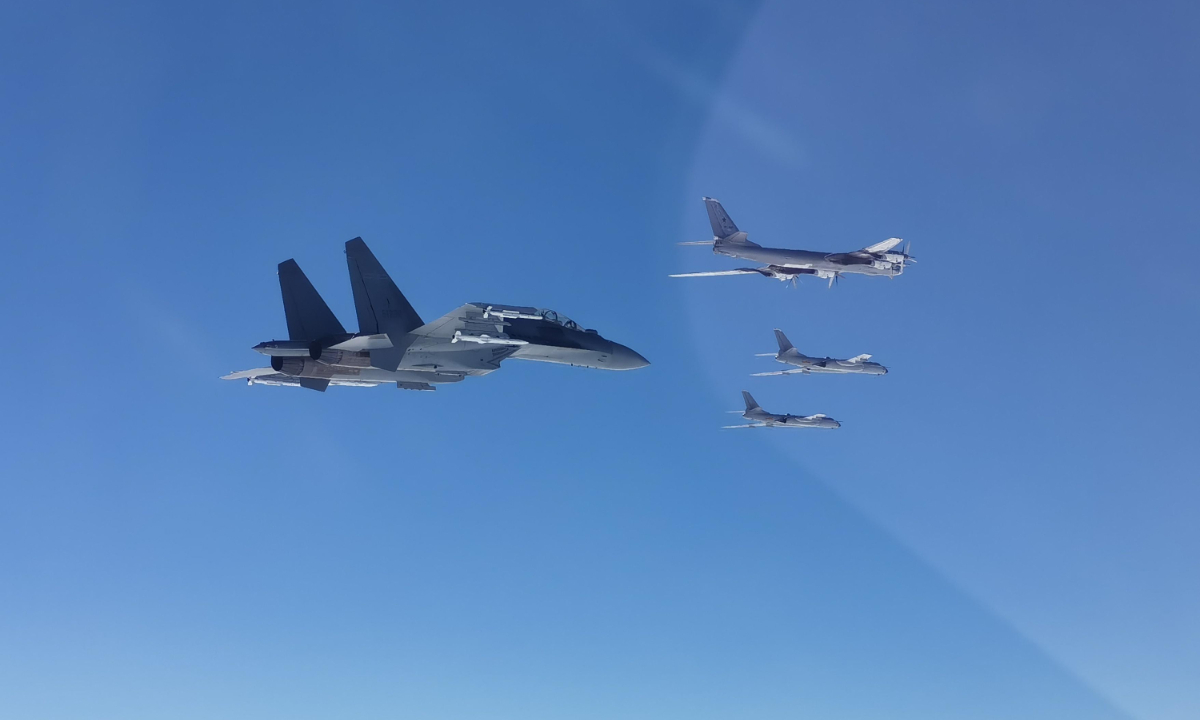
On December 16, 2025, Japan’s Defence Minister Shinjiro Koizumi reiterated serious concern over a China-Russia joint bomber flights near the Shikoku region in western Japan. Koizumi’s remarks came in response to a joint flight exercise held on December 9, 2025, when two Russian Tu-95 bombers flew from the Sea of Japan and rendezvoused with two Chinese H-6 bombers over the East China Sea, before continuing to the Pacific Ocean off the main island of Shikoku. The movements were spotted by the Japan Air Self-Defense Force (JASDF). Further, four Chinese J-16 fighter jets joined the bombers as they made a round-trip between Japan’s Okinawa and Miyako islands. Japan also detected simultaneous Russian Air Force activity in the Sea of Japan, consisting of one early-warning aircraft, an A-50 and two Su-30 fighters.


On December 10, 2025, U.S.-Japan joint air drills took place over the Sea of Japan, including two U.S. B-52 strategic bombers flying with Japanese F-35 stealth fighters and F-15 air-superiority jets, to demonstrate allied resolve in the face of Chinese and Russian joint military manoeuvres. On the same day, Japanese Defence Minister Shinjiro Koizumi stated that the Russian and Chinese joint operations were “clearly intended as a show of force against our nation, which is a serious concern for our national security.” Koizumi had also reiterated his views on a similar incident earlier, when a Japan Air Self-Defence Force F-15 was radar-locked locked by a Chinese J-15 aircraft off Japan’s Okinawa Prefecture for around 30 minutes on December 6, 2025, describing it as a “dangerous act.”
The crisis between Japan and China escalated with a diplomatic spat, after Japanese Prime Minister Sanae Takaichi, at a parliamentary meeting in Japan on November 7, 2025, stated that a Chinese attack on Taiwan could be treated as a “survival-threatening situation” for Japan, implying possible collective self-defence action, which drew a sharp rebuke from Beijing. After this incident, joint military cooperation increased between China and Russia’s military, signalling to Tokyo and Washington a willingness to operate in proximity to Japan’s strategic air approaches. Though the flights did not violate Japanese airspace, their route through key international straits like Miyako suggested a deliberate display of capability and endurance. However, a quick reinforcement of the US commitment to Japan through joint air drills reiterated the strategic importance of the U.S.-Japan alliance.
Many of these military activities are contextualised by heightened tensions over Taiwan. Japan’s government has repeatedly expressed alarm over Chinese military flights near Taiwan and has publicly tied its own security posture to potential contingencies involving the island. Meanwhile, on December 15, 2025, China’s Permanent Representative to the United Nations (UN), Fu Cong, urged Japanese Prime Minister Sanae Takaichi to retract her comments about Taiwan, and “refrain from continuing down the wrong path”. Fu Cong asserted at the UN Security Council, “At a time when the international community is jointly reflecting on history and planning for the future, it is outrageous that Takaichi has gone against the trend by claiming that the so-called survival-threatening situation for Japan is linked to Taiwan of China, and by implying and threatening that Japan would militarily intervene in the Taiwan question.”
The current trend of military cooperation and alliances between nations reflects a multipronged challenge to East Asia’s security structure. China’s assertiveness in projecting its military power seeks to normalise larger air operations near Japan and deter external support for Taiwan. Russia is in strategic alignment with Beijing to enhance its regional presence outside Europe. U.S.-Japan responses underscore allied resolve to uphold freedom of navigation and airspace monitoring. Additionally, North Atlantic Treaty Organization (NATO) chief Mark Rutte also shared their “grave concerns” about recent joint patrols by Chinese and Russian aircraft, deepening complications.
Despite these displays of joint military muscle, the absence of direct airspace violations indicates calibrated actions to avoid open conflict. Given the situation of major powers of the world, the threat perception remains complex, and impacts on the broader security of the region. Taiwan tensions, intertwined with Japan’s national security concerns, have evolved into a complex security dilemma, deeply entangled in alliance dynamics. Uncertainty will continue to afflict this conflict till both principals – Japan and China – come together to address the tensions diplomatically.
Author Shivangi Sharma is Senior Fellow at Institute for Conflict Management.
(The views expressed in the above piece are personal and of the author. They do not necessarily reflect Bharat Fact views.)