World Korea Forum 2026 Concludes In Delhi, Focus On India-Korea Ties And Indo-Pacific

By Vivek Sharma
New Delhi: The 27th World Korea Forum 2026 concluded in New Delhi on Wednesday after two days of discussions on India-Korea ties, Indo-Pacific dynamics, security on the Korean Peninsula, and economic and cultural cooperation.

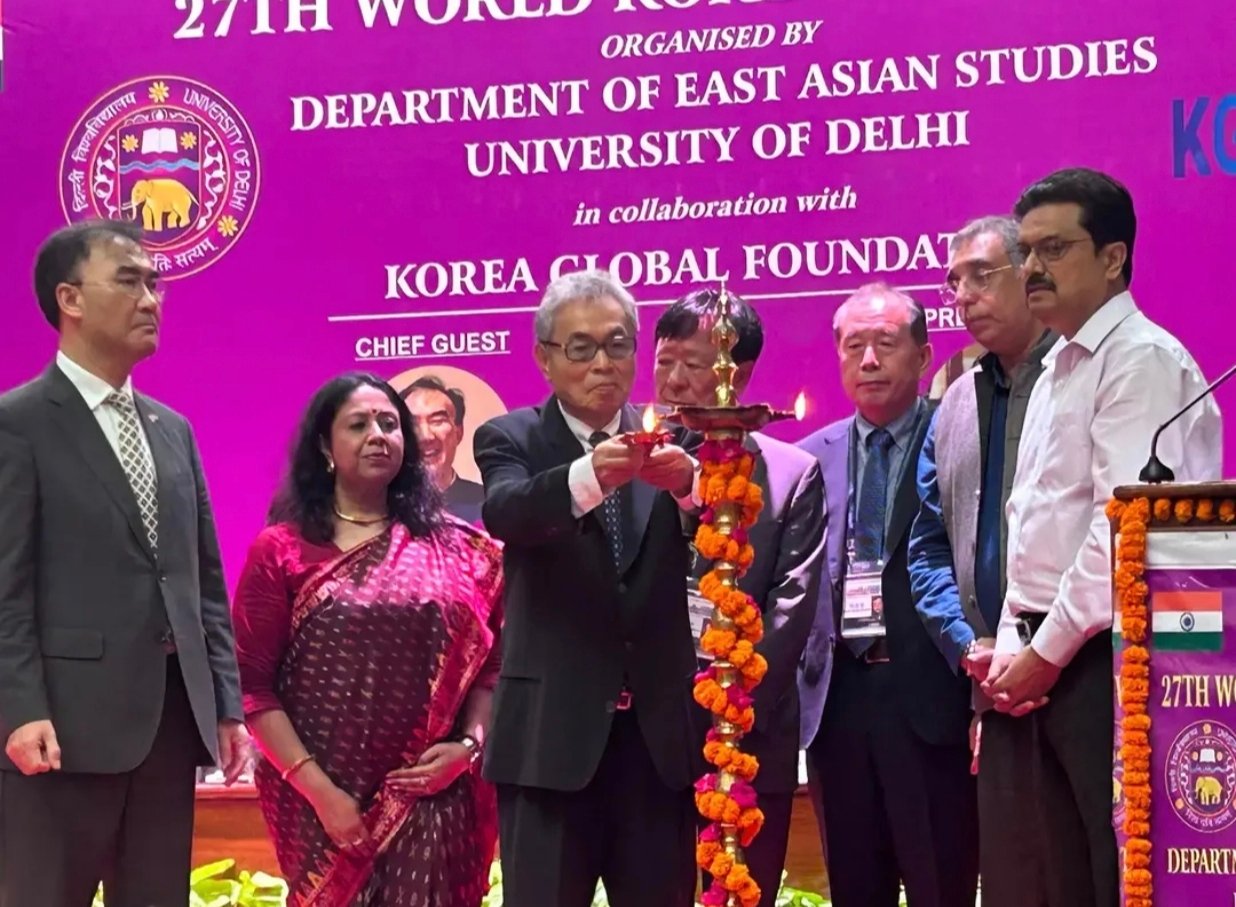
The forum was held on Aug 19-20 at Sir Shankar Lal Concert Hall, University of Delhi. It was organized by the Department of East Asian Studies, University of Delhi, in collaboration with the Korea Global Foundation.
The inaugural session was addressed by Prof. Yogesh Singh, Vice Chancellor, University of Delhi. He spoke on prospects for India-Korea cooperation in technology, education and research, including joint technology programmes, semester exchanges for students, joint PhD supervision and joint research laboratories. He underlined the role of universities, laboratories, industry, government policy, entrepreneurship and research investment in building such an ecosystem.
Korean Ambassador to India Lee Seong-ho spoke about the longstanding relationship between the two countries and expansion of cooperation across sectors. He stressed the need for solidarity among countries in navigating changes in the international environment and expressed hope that the forum would contribute to peace and prosperity.
Dr. Euy Don Park, President of the Southwest Asia Chapter Council, Peaceful Unification Advisory Council (PUAC) and Chair of the 2026 forum, said India is a strategic partner for peace and stability on the Korean Peninsula and in the wider Indo-Pacific. He said dialogue, mutual trust and cooperation are key to lasting peace.
Prof. Ranjana Mukhopadhyayaya, Head, Department of East Asian Studies, in her welcome address, said the forum comes amid rapid geopolitical, economic and technological shifts in the Indo-Pacific and highlighted the importance of academic dialogue and international collaboration.
In his message, Prof. Dr. Tshangchu Rhee, Executive Head of the Korea Global Foundation, highlighted the global reach of K-culture and stressed dialogue and exchange for peaceful coexistence on the Korean Peninsula.
The two-day programme saw participation of professors, researchers and experts from India, South Korea, China, Russia, Italy, Spain, Kazakhstan, Uzbekistan, Kyrgyzstan and the United Kingdom.
Sessions on the Korean Peninsula covered denuclearisation, nuclear self-reliance, inter-Korean relations, US-DPRK ties, North Korea’s relations with China and Russia, and India’s strategic role.
Other sessions discussed peace and unification, including the role of multilateral groups and the Global South, India’s perspective on unification, economic engagement between the two Koreas, and prospects for common security.
The forum also discussed broader global order, including the role of great and middle powers in the Indo-Pacific, Indian and Chinese perspectives on world developments, India-EU relations and reforms in global governance.
Economic sessions focused on economic security, fair trade, political economy of BRICS and the Global South, Korea-India cooperation in the Indo-Pacific era, ASEAN political economy and economic cooperation involving Russia and North Korea.
Discussions on diaspora covered Korean community abroad, Korean diaspora literature, Indian diaspora and transnationalism, and Korean communities in Central Asia.
Cultural sessions covered Rabindranath Tagore, Indian philosophy, K-Culture, K-Philosophy, migration and South-South cooperation, and the Gandhi-Nehru framework.