India, Japan deepen defence ties, warn against coercion at 2+2 talks in Tokyo

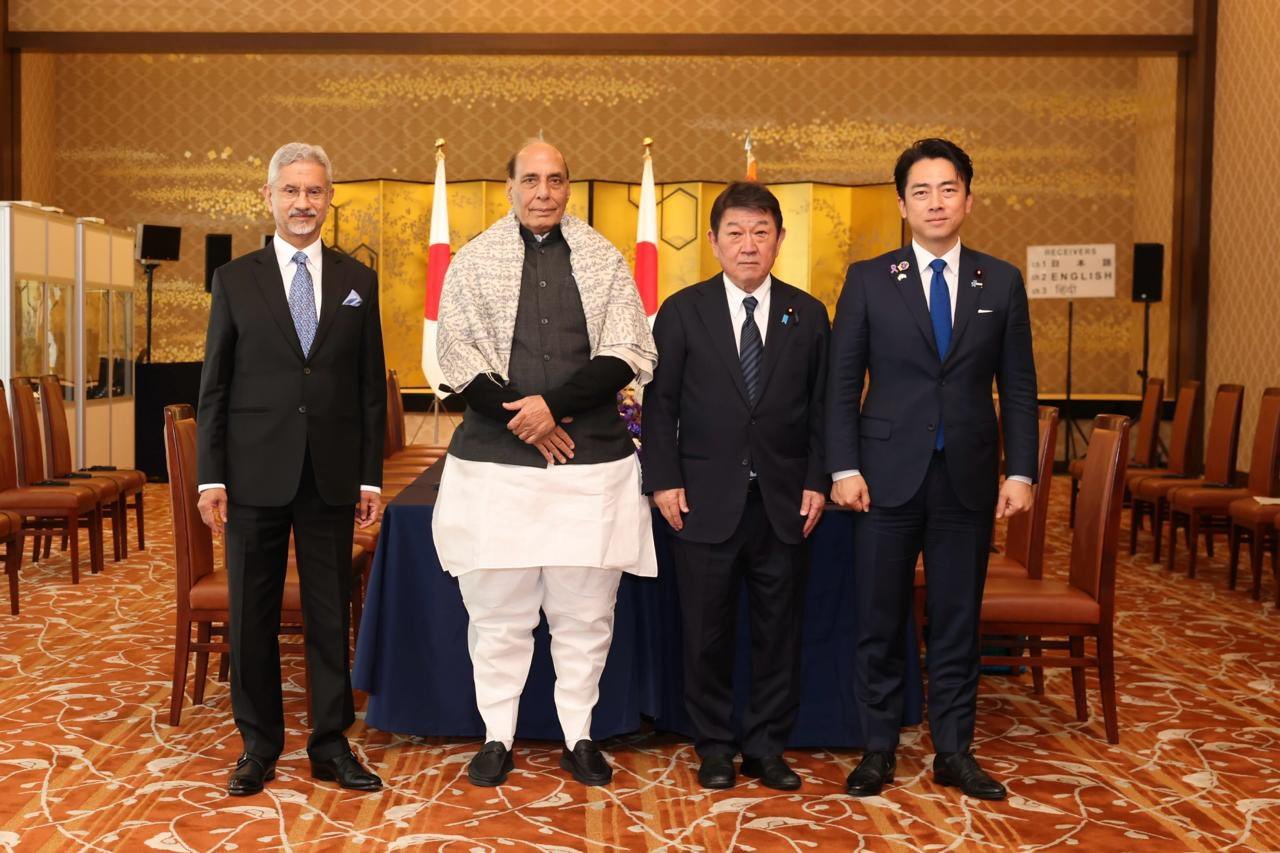
TOKYO :India and Japan held their fourth 2+2 Foreign and Defence Ministerial Meeting in Tokyo on Thursday, pledging to deepen defence, economic security and technology cooperation amid growing strategic convergence in an increasingly complex international environment.
Indian Defence Minister Rajnath Singh, External Affairs Minister S. Jaishankar, Japanese Foreign Minister Motegi Toshimitsu and Defence Minister Koizumi Shinjiro reaffirmed their commitment to a free, open and rules-based international order, respect for sovereignty and territorial integrity, and peaceful resolution of disputes without threat or use of force.


The ministers underlined the need for all countries to refrain from any attempt to unilaterally change the status quo, and to enhance synergy between India’s Indo-Pacific Oceans’ Initiative and MAHASAGAR and Japan’s updated Free and Open Indo-Pacific vision.
The ministers welcomed the growing defence partnership under the Joint Declaration on Security Cooperation adopted at the August 2025 Annual Summit. Japan briefed India on its ongoing revision of its National Security Strategy, National Defence Strategy and Defence Buildup Program.
They expressed satisfaction at the expansion of bilateral exercises, including the first-ever visit to India by Japan Air Self-Defence Force fighter aircraft for exercise Veer Guardian 26, and agreed to deepen cooperation through more complex exercises, integration of unmanned systems and exercises at short notice.
In a first, the two sides signed a Letter of Intent for the use of firing ranges in India, under which Japan Self-Defence Forces would conduct live-fire training, including surface-to-ship missiles, in India.
They also expected early formulation of UNICORN-related arrangements and India’s Acceptance of Necessity by February 2027, and looked to strengthen defence industrial cooperation under “Design with Japan, Make in India.”
Welcoming the recently signed Memorandum of Arrangement on Maritime Security Cooperation, the ministers agreed to move swiftly on concrete outcomes between the Indian Navy and the Japan Maritime Self-Defence Force, including maritime and air domain awareness, search and rescue, information sharing and humanitarian assistance and disaster relief.
They affirmed commitment to enhancing mine countermeasures capabilities and exploring joint development in naval shipbuilding and design, and welcomed expanding coast guard cooperation, including the 5th Coast Guard Global Summit to be held in India in February 2027.
On digital connectivity, the ministers agreed to enhance cooperation on trusted, redundant and high-speed undersea cable networks.
Noting rising cyber-attacks, they agreed to strengthen cybersecurity cooperation, including on AI-enabled cybersecurity and security of AI systems, and directed teams to renew the existing Memorandum of Cooperation and convene the next India-Japan Cyber Dialogue at an early date.
They also agreed to expand space cooperation, including Space Situational Awareness, use of space for Maritime Domain Awareness, and space-related rules and norms.
The ministers reiterated grave concerns over economic coercion, including arbitrary export restrictions, and non-market policies that result in overcapacity and disrupt global supply chains.
They welcomed the Joint Declaration on Economic Security Cooperation and agreed to promote project-based cooperation in semiconductors, critical minerals, information and communication technology, clean energy and pharmaceuticals.
On artificial intelligence, they affirmed India and Japan as strategic research and development partners, welcomed the Joint Statement on AI cooperation, and agreed to deepen cooperation under the Japan-India AI Cooperation Initiative (JAI).
The ministers unequivocally condemned terrorism and violent extremism in all forms, including cross-border terrorism, and called for concerted action against UN-listed groups including Al Qaeda, ISIS/Daesh, Lashkar-e-Tayyiba and Jaish-e-Mohammad and their proxies.
They reiterated commitment to UN Security Council reform, including expansion in permanent and non-permanent categories, and expressed mutual support for each other’s candidatures for a permanent seat in a reformed council.
The ministers agreed to celebrate 2027 as the India-Japan Year of Shared Horizons to mark the 75th anniversary of diplomatic relations, and decided to hold the next 2+2 meeting in India.